 Sleep Cycle Calculator
 Sleep science, explained simply
What is a sleep cycle, and how long does it last?
A sleep cycle is one full loop through the stages of sleep, light, deep, and REM, and it takes about 90 minutes. Everything the bedtime and wake-up calculators on this site do is built on this one number.
If you have ever woken up after 8 hours feeling groggy, or after 6 feeling surprisingly sharp, the sleep cycle is usually why. Sleep is not one flat state from lights-out to alarm. It moves through a repeating sequence of stages, and where that sequence ends when your alarm goes off matters as much as how many hours were on the clock.
The short answer
A single sleep cycle lasts about 90 minutes, though it can run anywhere from 80 to 120 minutes depending on the person and the night. Over a full night, most adults move through 4 to 6 cycles. Each cycle has four stages: three stages of non-REM sleep followed by a stage of REM (rapid eye movement) sleep, and the mix shifts across the night, with deep sleep concentrated early on and REM stretching longer toward morning.
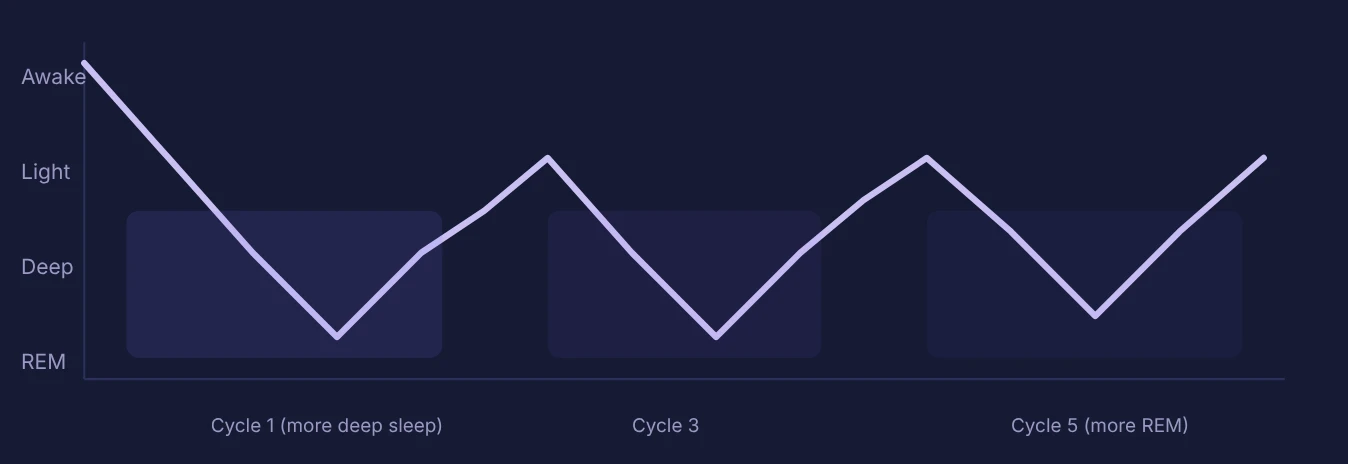
A simplified sleep architecture chart. Deep sleep dominates the early cycles; REM takes up a larger share toward morning.
The four stages inside one cycle
Stage 1 · Light sleep (drifting off)
Lasts just a few minutes. Breathing and heart rate start to slow, muscles relax, and it is easy to be woken up with barely any grogginess.
Stage 2 · Light sleep (true sleep begins)
The largest single stage across a night. Body temperature drops, heart rate slows further, and brain activity shows short bursts of activity that help lock in memory.
Stage 3 · Deep sleep
The hardest stage to wake from. This is when the body does most of its physical repair, tissue growth, and immune-system work. It is concentrated in the earlier cycles of the night.
REM sleep
Brain activity picks up, eyes move rapidly, and most dreaming happens here. REM supports memory consolidation and emotional processing, and each REM stage gets longer as the night goes on.
Why the cycle count matters more than the hour count
Waking up in the middle of deep sleep is what produces that heavy, disoriented feeling often called sleep inertia. Waking up at the boundary between cycles, when sleep is naturally lighter, tends to feel noticeably easier, even with the same total hours. This is the entire logic behind planning sleep in 90-minute blocks rather than picking a random number of hours: 7.5 hours (5 full cycles) and 9 hours (6 full cycles) both land on a cycle boundary, while 8 hours lands in the middle of a cycle for a lot of people.
Want this worked out for your own bedtime or wake-up time? The sleep cycle calculator does the 90-minute math for you and shows every valid option.
How many sleep cycles do you actually need?
| Cycles | Approx. hours | What it generally means |
|---|---|---|
| 3 cycles | ~4.5 hours | Short night. Fine as a rare exception, not sustainable. |
| 4 cycles | ~6 hours | On the low end for most adults, workable occasionally. |
| 5 cycles | ~7.5 hours | Solid, within the recommended range for most adults. |
| 6 cycles | ~9 hours | Full, restorative night, upper end of the typical adult range. |
Most adults land comfortably at 5 to 6 cycles. Teenagers and children generally need more cycles than adults, not because each cycle is longer, but because their bodies are still developing and benefit from more total sleep time.
What throws cycles off
- Inconsistent bed and wake times make it harder for the body to settle into a predictable cycle rhythm night to night.
- Alcohol tends to suppress REM sleep in the first half of the night, then rebounds later, which is part of why a night of drinking often leads to lighter, more fragmented sleep.
- Caffeine late in the day delays the onset of deep sleep and can shorten the early, deep-sleep-heavy cycles.
- Stress and screen use before bed extend Stage 1 and Stage 2, pushing the first deep-sleep stage later and effectively shortening the night’s useful cycles.
Frequently asked questions
A typical sleep cycle lasts about 90 minutes, though it can range from roughly 80 to 120 minutes depending on the individual and even the specific night. Over a full night’s sleep, most adults complete 4 to 6 of these cycles back to back.
Most adults do best with 5 to 6 complete cycles a night, which works out to roughly 7.5 to 9 hours. Fewer than 4 cycles (around 6 hours or less) tends to leave most people under-rested if it happens regularly.
REM sleep occurs once in each of the 4 to 6 sleep cycles per night, so most people experience 4 to 6 REM periods nightly. The early REM periods are short, often just 10 minutes, while the later ones, closer to morning, can stretch to 30 minutes or more.
Generally yes. Waking up near the boundary between two cycles, when sleep is lightest, tends to feel easier than waking up mid-cycle during deep sleep, even if the total hours slept are similar. This is why planning sleep in 90-minute increments can make mornings noticeably easier.
To an extent. A short 20-minute nap stays in light sleep and skips deep sleep and REM entirely, which is why it is easy to wake from. A full 90-minute nap completes one full cycle, including REM, and tends to leave you more refreshed than a nap in the 45 to 60 minute range, which often ends mid-cycle.